Look over here, terrorists are always out to get us
Michael Hastings and Glenn Greenwald discuss how many in the mainstream media fuel the never-ending “war on terror”
You have to laugh. Or you’ll cry.
Has Murdoch’s Australian gone mad? Has it dared speak honestly about Israeli repression in Palestine? The Zionist lobby is outraged. Er, well, Foreign Editor Greg Sheridan – a man who has enjoyed countless free Zionist lobby trips to Israel, all for research purposes, of course – is having none of it today:
Many readers were surprised, as I was, to read a headline in The Weekend Australian: Living under the cloud of Israel’s cruel apartheid. The headline did an injustice to the story, which only used the word apartheid in reporting the comments of one person who was interviewed. The editor of this august journal has confirmed to me that the headline was a mistake, the sort that creeps into newspapers where staff are always battling the pressure of deadlines. The Australian believes, and certainly I personally believe, the word apartheid has no application to Israel, which is a democracy in good standing, which extends basic rights to all its citizens, whatever their race or creed. Too often the misuse of such a word is designed to demonise Israel, wholly unjustly. In this case, it was just a mistake.
Putting aside a clueless BBC interviewer – it’s so clear that she thought she had to continually interrupt Finkelstein to be “balanced” – there’s a good discussion about young Jews turning away from Israel and the Zionist state’s seeming dedication to destroy itself:
Let’s imagine this scene: eleven Palestinian youngsters under the age of 18 demonstrating with Palestinian flags and posters at the north-west entrance of the Ariel settlement, demanding that the old road which leads to Salfit be reopened. Let’s assume that these youngsters aren’t attacked by the Ariel residents. After all, this is not a hotheaded settlement, its zealotry is limited to land fever.
Nonetheless, under military procedures, the youth are violating security codes relating to “a prohibition of incitement activity and hostile propaganda,” which were signed by then-GOC Central Command Uzi Narkiss in August 1967. The bans apply to “a group of 10 or more people who gather at a site for a political purpose, or for a matter that can be interpreted as being political,” such as waving a flag or distributing incendiary (“incitement” ) materials. Even if they are aged 13 to 17, these imaginary demonstrators can be detained and interrogated for eight days before they are brought to a military tribunal.
What happens to Jewish youth of the same age who mutilate trees on lands belonging to Palestinian villages in the Salfit district? Even though they live in the same area as the Palestinian youth, a different law applies to them: Israeli law. Under Israeli juvenile law, should IDF soldiers or police make the effort to detain Jewish youth for mutilating trees, minors under the age of 14 can be held for up to 12 hours, and minors over the age of 14 can be detained for 24 hours. Israeli military law does not distinguish between a Palestinian minor and an adult when it comes to their primary detention, before trial. Palestinian detainees under and over the age of 18 can be held for eight days. One country, two legal codes.
For some people, this circumstance of double standards contradicts human logic, professional norms and ethics. In 2010, two petitions were lodged with the High Court of Justice disputing such structural discrimination: Attorney Lila Margalit represented the Association for Civil Rights in Israel, Yesh Din-Volunteers for Human Rights and the Public Committee Against Torture in Israel; attorneys Smadar Ben Natan and Avigdor Feldman represented the Palestinian Ministry of Prisoners’ Affairs. The petitioners sought to make prearraignment detention periods for Palestinian suspects equivalent to those of Israeli suspects.
And as often happens, a rare coincidence was discovered: The state prosecutor’s January 2011 response to these High Court petitions indicated that “a decision was reached recently to institute far-ranging changes in detention periods designated under the security codes; these changes are supported by the IDF, the Israel Police and the Shin Bet security service.”
These “far-ranging” changes were incorporated in an amendment to the military codes signed by then-GOC Central Command Avi Mizrahi on February 2, 2012, which are gradually being instituted between March 1 and August 1. The amendment reduces the period of detention, but does not equalize the period of detention faced by Palestinian and Israeli suspects. This disparity, explained the prosecutor, is justified in terms of the essence of “territory under belligerent occupation for a long period of years.” The inequality is substantiated via reference to the “fanaticism” of Palestinian detainees who operate on the basis of “ultra-nationalist, ideological motivations,” and so “interrogation of them is more difficult.”
This is basically propaganda for a new computer game (even if it claims to be a documentary) and yet the film provides disturbing insights into how the merging between reality and fiction is here:
I was interviewed last week by the independent program Earthwise. We discussed the importance of Wikileaks and its challenge to the mainstream media:
Audio clip: Adobe Flash Player (version 9 or above) is required to play this audio clip. Download the latest version here. You also need to have JavaScript enabled in your browser.
Business reporting often ignores the vast bulk of human beings and focuses solely on company profits. Take this lead story in today’s Murdoch Australian:
Papua New Guinea specialist Highlands Pacific has long been known as an asset-rich, share-price-poor type of stock. There is a feeling out there that this year could well see that change for the better, due to a couple of milestones that are to be clocked up.
The first is the commissioning of the $US1.5 billion ($1.47bn) Ramu nickel-cobalt project in PNG, 8.56 per cent-owned by Highlands and with the ability for it to go to an eventual 20.55 per cent stake.
China’s MCC is the major partner and operator of the project, which has cost more than originally planned and is two years behind schedule.
None of that really matters to Highlands as it has been carried in the development.
Assume a long-term nickel price of $US9 a pound (now $US8 a pound) and Highlands could receive $US3 million-$US5m a year up until about 2018, when project debt is assumed to be paid off. After that, Highlands’ stake increases to 11.3 per cent and its share of free cashflow could be $US15m-$US20m a year, with the option to go to a 20.55 per cent equity interest should it desire.
All that is not bad in itself for a company that yesterday was being valued by the market at $106m (15.5c a share).
Given Ramu’s development cost, it seems fair enough to suggest Highland’s market cap is covered by the Ramu interest alone.
But just like a late-night TV ad throwing in steak knives as part of the deal, there is more to Highlands, most notably its 18.8 per cent stake in the Xstrata-led Frieda River copper-gold project in PNG.
It is one of the world’s biggest undeveloped copper-gold deposits (12.9 million tonnes of copper and 20 million ounces of gold). Xstrata delayed a feasibility study into its development to December this year.
That raised concerns in some quarters that Xstrata had gone cold on the project. But the reality is that Xstrata delayed it to study power options for Frieda River in greater depth. The emerging availability of gas in that part of the world means that the original plan for an $US810m hydro-power project could be replaced with the cheaper option of gas-fired power.
Like Ramu before it, the delay at Frieda River is neither here nor there, given that when it is developed it is going to be around for decades.
Throw in Highlands’ exploration hunt near the almost exhausted Ok Tedi copper-gold mine in the Star Mountains in PNG, and it is easy to see why valuations of Highlands runs well ahead of its current share price. Euroz settled on a 40c share price target in a recent research note on the company after first having arrived at a 51c valuation.
Understand any of that? Of course you didn’t, you’re a real person who actually wonders what social and environmental impact such explorations may have on the poor people of PNG.
Here’s the Oxford Business Group highlighting calls for the PNG government to make sure these vast revenues don’t all leave the country:
A series of significant mineral finds in Papua New Guinea (PNG) have highlighted the role exports are set to play in the nation’s economic future. However, there have been calls from industry players and opposition officials asking the government to do more to ensure revenues stay in the country.
In mid-April, state-owned Petromin announced that it had found a 364-metre intersection of porphyry copper, molybdenum and gold mineralisation at its Ipi River prospect, located 50 km north of its Tolukuma gold mine in Central Province.
In the same month, Australia-based Indochine Mining announced that gold and silver finds at Mount Kare had underlined the “outstanding potential” of the project to become one of PNG’s next major mining operations. Officials also revealed that KULA Gold’s Woodlark Island project, which has estimated reserves of 700,000 ounces, was on track to start producing in 2014.
The World Tomorrow is becoming essential weekly viewing (here’s past episodes). The latest edition features Alaa Abd El-Fattah from Egypt and Nabeel Rajab from Bahrain, two remarkable men who show dedication to free their countries from internal and external (read US) tyranny:
A disaster is not the event itself, but the trauma of the event. By adjusting to looming collapse in advance, your lifestyle can change gradually, at your own pace. ARK-INC offers holidays in apocalyptic landscapes, low-tech home comforts, and materials for self-evaluation.
The number of lawsuits filed by multinationals against governments is growing globally. It truly shows who controls this world.
It’s time for a serious fight-back. Evidence for the prosecution (via the Guardian):
Lloyds Banking Group has become embroiled in a row over its investment in a company accused of involvement in the rendition of terror suspects on behalf of the CIA.
Lloyds, which is just under 40% owned by the taxpayer, is one of a number of leading City institutions under fire for investing in US giant Computer Sciences Corporation (CSC), which is accused of helping to organise covert US government flights of terror suspects to Guantánamo Bay and other clandestine “black sites” around the world.
Reprieve, the legal human rights charity run by the British lawyer Clive Stafford Smith, alleges that during the flights, suspects – some of whom were later proved innocent – were “stripped, dressed in a diaper and tracksuit, goggles and earphones, and had their hands and feet shackled”. Once delivered to the clandestine locations, they were subjected to beatings and sleep deprivation and forced into stress positions, a report from the International Committee of the Red Cross says.
CSC, which is facing a backlash for allegedly botching its handling of a £3bn contract to upgrade the NHS IT system, has refused to comment on claims it was involved in rendition. It has also refused to sign a Reprieve pledge to “never knowingly facilitate torture” in the future. The claims about its involvement in rendition flights have not been confirmed.
Reprieve has written to CSC investors to ask them to put pressure on the company to take a public stand against torture.
Some of the City’s biggest institutions, including Lloyds and insurer Aviva, have demanded that CSC immediately address allegations that it played a part in arranging extraordinary rendition flights.
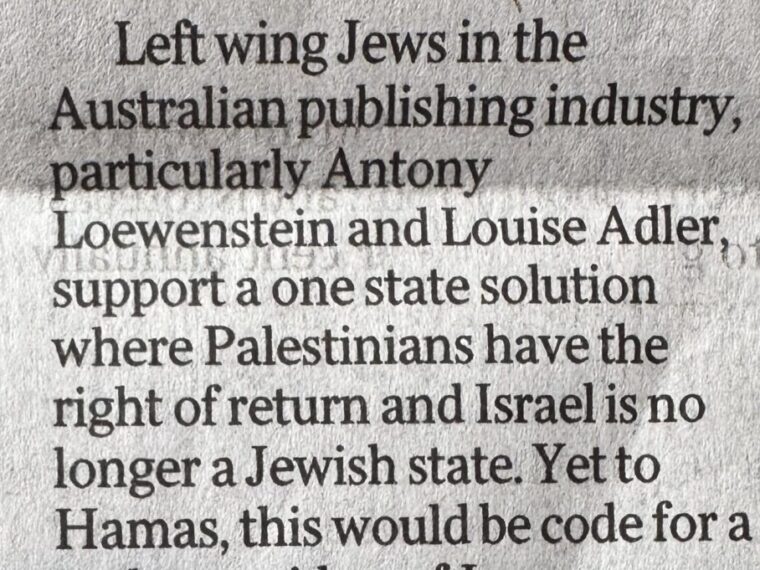
Tragically, many Australian Jews take comfort from this same delusion, almost enjoying imagining it’s 1933. All the time.
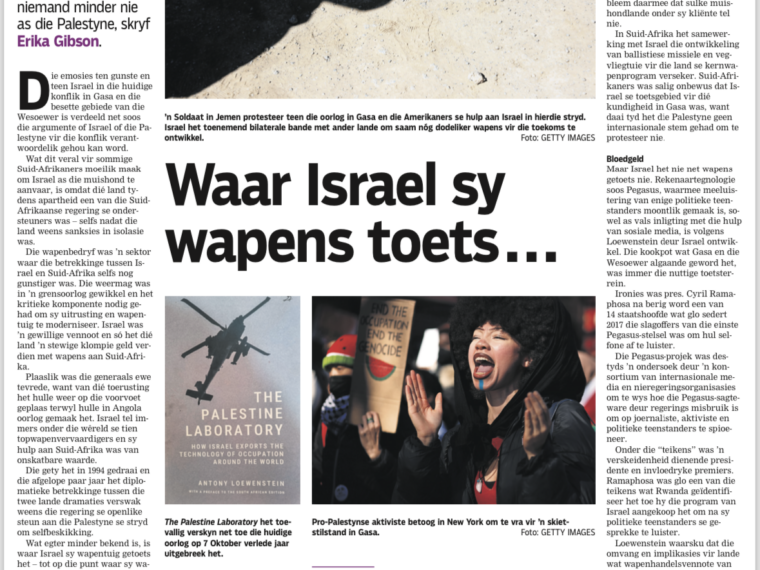
This piece from a South African newspaper highlights the dilemma and hopes for a much better future:
Of all the studies conducted on the position of the Jewish establishment during apartheid, perhaps the most authoritative has been Gideon Shimoni’s Community and Conscience: The Jews in Apartheid South Africa. Published in 2003, the text argues that while individual Jews protested the laws of the National Party regime in numbers disproportionate to the relative size of the community—Jews, after all, never made up more than 4% of the white minority—the semi-official leadership tacitly accepted the policies of race-based discrimination.
…
There are some Jews in South Africa who, while fully supporting the principles on which the Jewish state was formed, do not support the Netanyahu administration “right or wrong”. Unfortunately, this is not a minority that is growing nearly as fast as the Beinart faction in America, and most evidence would suggest it is not growing at all. Young South African Jews appear either to be turning to religion (where old ways of thinking predominate), are failing to respond to the Israel question with an updated set of facts (for instance, the fact that the Netanyahu administration is once again offering Israelis incentives for settling in the territories), or are abandoning the debate altogether.
So the South African Jewish community, given its compromised history, may have greater need of a voice like Peter Beinart’s than the Jews of the United States. A cause for hope is that South African Jewry can also claim a list of names that spoke against the mainstream when the consequences were more severe than excommunication.