The Australian right to target businesses complicit with Israeli occupation

The position of BDS [boycott, divestment and sanctions] in Australia remains highly relevant. Debating Israeli apartheid in Palestine is necessary. This case starts today:

On May 1, 19 Melbourne activists will be put on trial for their political activity. In a precedent-setting case, these pro-Palestine activists will be fighting a variety of charges designed to criminalize dissent in Premier Ted Baillieu’s state of Victoria and to intimidate supporters of Palestine in Australia.

On July 1, 2011, Victoria police attacked a peaceful demonstration in Melbourne’s central business district. In one of the largest political arrests in a decade, 19 activists were detained during a boycott, divestment and sanctions (BDS) action against the Max Brenner store. The chocolate shop is owned by Israeli conglomerate, the Strauss Group, a company that provides “care rations” for the Israeli military, including the Golani and the Givati brigades.

These were two of the key Israeli military brigades involved in Israel’s brutal assault on Gaza in December 2008/January 2009 that killed more than 1,300 Palestinians. In more recent times, the Golani brigade has been noted for its enforcement of Israeli colonization of Palestinian Hebron in the West Bank.

After a series of peaceful demonstrations against Max Brenner, the July 1 action was kettled by police, and then activists were individually targeted in an unprovoked attack. The police used pressure point tactics on some of the demonstrators; others reported bruising and rough treatment. One woman had her shoulder dislocated.

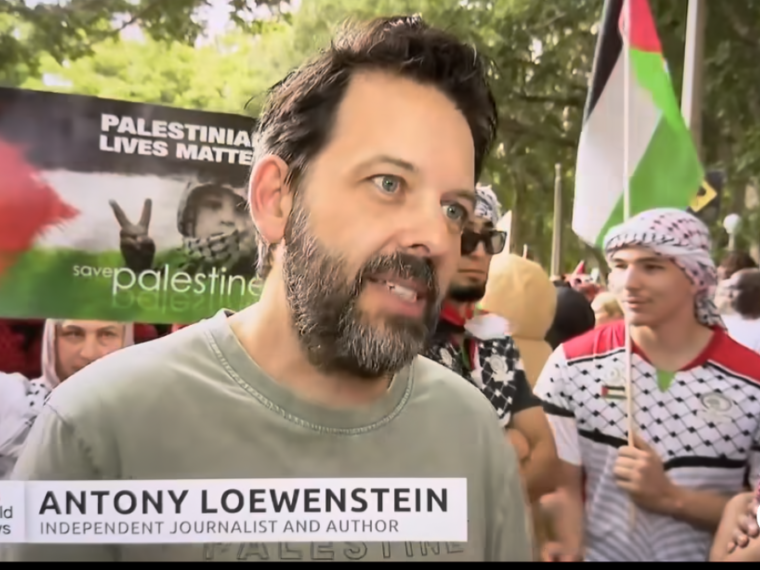
I was asked by some of the key activists involved in the case to record a message of solidarity:

2 comments

Private military and intelligence still alive and well in Afghanistan

My following investigation appeared in Australian publication Crikey last week:

The private security compound is on the outskirts of Kabul, along the road to Jalalabad, a notorious strip of highway, the landscape is predominantly industrial, with shipping containers set against a string of mountains on the horizon. Several logistics companies sit behind these concrete walls — this is an industry that has enjoyed a massive growth spurt since the US-led, 2001 invasion in Afghanistan.

While Indian Gurkhas trained outside to join the company’s ranks, “Scott”, a former British soldier and now the Western head of one of the country’s leading private security firms, explains that “we don’t call ourselves mercenaries” but a reliable corporation that provided “static” security for foreign embassies, journalists, aid companies, hotels and other key assets. Launching in Afghanistan soon after the US invaded, “we survive off chaos”.

“From 2002 onwards,” says Scott, “we worked with the Afghan government because the Ministry of Interior (MOI) could not secure businesses or people and Western insurance companies insisted on using a private military company [PMC]. Internationals felt they could not trust MOI when moving province to province.”

This is the reason such an industry self-perpetuates even though President Karzai has demanded for years that these companies be replaced with the interior ministry’s Afghan Private Protection Force (APPF).

According to Scott, the implementation of Karzai’s plan this year has been “chaotic”. During our interview, he received a call from an American client who didn’t understand Karzai’s new PMC rules. “This happens all the time at the moment. For example, an Afghan is supposed to be assigned in every PMC in the country but this has never happened.”

The complicated realities of modern conflict has served as the stated rationale for this massive growth industry globally, especially in war zones since September 11. Scott offers a simpler explanation. “The Americans, British and foreign forces in Iraq and Afghanistan are not big enough to re-build nations, so PMCs are needed to fill the void. We protect contractors building prisons and schools. If the US had used more troops, we would not be necessary.”

The West has now been in Afghanistan longer than both World Wars combined. The US has spent tens of billions of aid money in the country and yet working services are minimal.

Apart from the escalating rate of civilian deaths, from Taliban and Western forces, the rise of private security armies has defined the war, resulting in numerous contractor crimes against Afghan civilians. The record of Western security firms is filled with a troubling lack of justice for victims.

Two Afghan men sit upstairs in a simple restaurant near the centre of Kabul — both have families who’ve suffered privatised violence first hand. Tariq-U-Rahman and Fahim, both from Wardak Province, explain that they’ve faced threats from three elements; the Taliban, the US army and private security companies, and were subsequently forced to move to Kabul.

Afghan firms have been hired and empowered by the US military to transport their equipment across the country. The job is to guard the convoys but they regularly establish so-called security perimeters and in the process engage in fire-fights with the Taliban, wantonly harming civilians. One of the worst offenders is Watan Risk Management, a leading company with close ties to the Karzai family that pays off the Taliban not to attack US convoys.

Fahim says his cousin, a shopkeeper, was shot dead by a Watan guard a year ago for no other reason than being in the wrong place at the wrong time. Watan admitted fault, he said, and offered $US20,000 compensation but the family is still waiting for the money. The victim’s wife and children are now struggling despite the family financially assisting them.

Fahim explains that private security companies could be necessary in other countries with more stability but in Afghanistan it had only brought “misery and violence”.

The current situation in Afghanistan confirms his scepticism. M. Ashraf Haidari, a suave, American educated senior Afghan official who is the deputy assistant national security adviser and senior policy and oversight adviser to Karzai, told me that Afghan authorities were shutting the “illegal and without licence” firms and “the new rules attempt to regulate the system”.

But several Western and local security corporations confirmed to me off the record they were still operating in the area and imagined doing so for years to come, finding ways around the new rules. Furthermore, a couple of PMCs that the Karzai government said had been shut down were still operating even if signs around their compounds were removed.

“Many embassies, for example, simply won’t trust the Afghan Private Protection Force (APPF) and will continue to rely on foreign security companies,” one said.

The supposed logic of the mass expansion of the security industry post-September 11 globally is to replace tasks the state’s military can’t or won’t do. But in a poor nation such as Afghanistan resentment built quickly, I was consistently told, when it was discovered that the Afghan army was getting paid substantially less than the private militias.

Outsourcing security isn’t the only task that has become privatised in the Western-led mission. Intelligence is increasingly collected by private companies and given to American, Australian and British forces.

Some privatised intelligence has involved the hiring of corporations to gather information about Afghans that is then used by the military for so-called counter-insurgency. Jeremy Kelly in the London Times first published extracts in late March of extensive documents by US-based “consultancy company” AECOM — the company had been hired by NATO to spy on mosques, universities and the general community throughout the country. The work started just over a year ago.

I viewed dozens of pages of this intelligence (and extract below different sections to the Times). The files detail conversations from March 2012: people complain about the Karzai government’s corruption and inefficiency; clerics in mosques demand Western forces leave immediately; family members complain about proposed marriages between the Taliban and local girls; others express support for the insurgency and complain of troubles when working in Iran.

The research comes from a range of districts and is separated between “supportive” and “non-supportive” individuals of the NATO mission.

One entry, from March 14 in the Sheberghan District, details an “overheard conversation between two Uzbek males between the ages of 40-45 at market.”

“One man said, ‘The other day I was riding on a bus when it became very windy. It seemed as if it was raining dust. People were saying that this could be a sign God’s wrath. This is happening to us because the Americans have burned the Quran, but we are calmly sitting idle. We should be rising up against the Americans for what they have done. We are being punished for doing nothing.’

“The other resident stated, ‘I do not know, but it might be possible’.”

In another extract, from March 15 in Shahr-e-Safa in a public car, an Afghan spy overheard “two concerned men ages 50 to 60, discussing private escort companies threat to the safety of civilians.”

“The first man said, ‘People distrust the private escort companies because when a Talib fires at them, they return fire at houses, people, even the trees are cut if a Talib is shooting from behind them!’

“The second man replied, ‘Most of the time, innocent people are killed or injured in the crossfire.  People want the government to either make sure escorts do not harm civilians or disarm them’!”

Such details appear as mundane, normal and daily conversations by local villagers across the state, but they can form the knowledge for US-led night-raids that cause deaths and deep Afghan anger. Mistakes are routinely made. Innocent men are kidnapped. Many are killed.

The recent announcement that Afghan forces would now take thelead on night-raids was dismissed as propaganda by sources in Afghanistan, a face-saving exercise by the Karzai government to show it has sovereignty in its own country.

Meanwhile, the US military and its allies have little idea of the agendas of the Afghans giving them intelligence. It’s why respected organisations such as The Afghanistan Analysts Network refuse to undertake commissioned work for clients, concerned that its research may be co-opted for military means.

As soon as the Taliban was toppled in 2001, Northern Alliance forces and its friends routinely issued payback against enemies, real and imagined. Even today, a local warlord and police chief in Uruzgan Province, Matiullah Khan, is using Australian forces to take out his rivals and fuel conflict.

A reporter from the Chicago Tribune witnessed this trend as far back as November 2001.

Western forces enabled this behaviour by using provided intelligence and arresting, bombing and interrogating people they were told were Taliban. In reality, the information was often wrong. Crucially, it reinforced the Western belief that any breathing Taliban should be a dead Taliban.

That was then. Today, the US government realises it will have to negotiate with the Taliban but is hiring private firms to better understand who should be targeted first.

Privatised security and intelligence is now a natural part of Western war making. America simply cannot and will not launch missions without the backing of often unaccountable companies that complement its defence industry. Since the departure of US troops from Iraq, thousands of foreign contractors still populate the country, that doesn’t look set to change any time soon.

*Antony Loewenstein is an independent journalist and author who is currently working on a book and documentary about disaster capitalism.

no comments

ABCTV News24′s The Drum on Afghanistan and Murdoch scandal

Last night I appeared on ABCTV’s The Drum (video here) talking about a range of Australian issues, Afghanistan and Murdoch thuggery in Britain.

Having just returned from Pakistan and Afghanistan, I talked about the reality of life in the latter under Western occupation and what’s likely to happen once most troops leave at the end of 2014. After more than a decade and tens of billions of aid (see this telling photo by my friend Benjamin Gilmour who just returned from Kabul and Herat) the nation is in a state of (mostly) chaos. Resistance to American and Australian forces have undoubtedly led to a Western defeat but what comes next? Many Afghans I met said they feared what would happen after the West leaves. This wasn’t because they wanted them to stay, although some did, but that Western aid and development should in some way assist the state. The time for war is long over.

I explained on the program that the West have empowered thuggish warlords; we’ve trained, armed and funded men with a horrific record in the name of “stability”. In reality, it’s created the opposite. I was researching the role of private militias and intelligence companies, both of which have corrupted the democratic process.

I heard over and over again how little America and its allies knew about Afghanistan despite spending more than 10 years fighting the Taliban and other forces.

In relation to the ongoing Murdoch saga in Britain, I argued that News International could rightly be called a mafia-like organisation and James Murdoch, who just gave testimony last night to the Leveson Inquiry, openly explained the intimacy between the Tories and his corporation (not that things were any better or different during the days of Tony Blair and Gordon Brown).

no comments

Australia sharing disaster capitalism skills with Afghanistan

Dispiriting news. Australia, apparently so proud of exploiting resources, now wants to share this knowledge with a poor nation such as Afghanistan that is open to vulture capitalists. The Australian reports:

Afghanistan is looking to the Australian mining industry for instruction and investment as the war-torn nation stakes its stability and economic future on the success of its nascent natural resources sector.

An Afghan Ministry of Mines delegation will tour Australia in coming weeks on an industry roadshow to convince Australian mining companies that the opportunities for mineral exploitation outweigh the security risks.

The government is also seeking Australian expertise in the creation of an Afghan school of mines. Mines Minister Wahidullah Shahrani said, “Australia is a model for us”.

“The government of Australia has been very generous to help us with our technical capacity, give us scholarships for postgraduate programs in the mining area and we’ve also been sending some people to the Australian department of mines and petroleum,” he told The Australian.

Afghanistan is sitting on enormous mineral wealth.

A review of Soviet-era survey data by the US Geological Survey estimates oil reserves of three billion barrels, 15 trillion cubic feet of natural gas, and significant copper, gold, iron ore, gemstone and lithium deposits.

The survey valued the country’s known natural resources at about $US1 trillion ($970bn), although Mr Shahrani says it could be three times that amount given only 30 per cent of Afghan territory has been surveyed.

Three decades of war and insecurity, coupled with widespread illiteracy, have in the past prevented the successful exploitation of Afghanistan’s minerals wealth.

But with most coalition forces pulling out in December 2014, and international aid to decline after that date, Afghanistan’s future depends heavily on the successful exploitation of its minerals.

“By 2016 we expect revenues to government from mines will be at least $1.5 billion,” Mr Shahrani said.

et security – as ever – remains Afghanistan’s biggest problem.

Major Western mining companies such as Rio Tinto are understood to view Afghanistan, even under NATO forces, as too dangerous and everyone is jittery about the post-2014 landscape when security fully transfers into Afghan hands.

The government has tried to allay those fears by creating a Mines Protection Unit that will secure all projects at the state’s expense.

But it must also convince its own population – weary of occupation and wary of strangers – that foreign exploitation of its mineral resources is the key to its future.

Mr Shahrani says involving local communities in mining projects, through local jobs and community spin-offs, is the best way to reduce risk.

In coming months Kabul will begin a public awareness campaign, sending groups of MPs, officials and journalists to Australia to see the economic benefits mining can deliver.

Mr Shahrani said: “Afghanistan has never been a major mining country, unlike South Africa, Kazakhstan or Australia, so people need to be able to understand its potential.”

no comments

Australians deserve truth about Afghanistan (and media and political complicity in the mess)

Australia is ruled by craven fools, desperate to shield the public from the reality of the war in Afghanistan. We lost years ago. The Sunday Age:

Australian officials have rejected an expert report critical of conditions in Afghanistan, demanding that it be rewritten to match upbeat government claims of dramatic progress and improved security.

The independent consultants’ report, commissioned by the government’s aid and development agency AusAID, is at odds with optimistic official assertions about conditions in Afghanistan’s Oruzgan province, where Australian troops operate.

The Sunday Age has learnt that AusAID pressed for changes in the report, with some sections relating to security toned down and others cut entirely. The pressure came as the government accelerated the phased withdrawal of Australian troops, citing greater security and the growing ability of the Afghan army.

While AusAID denied trying to dictate the content of the report, a spokeswoman said it was standard practice for the agency to seek corrections to ”factual inaccuracies” and ”clarifications between fact, perception and analysis”.

She confirmed that AusAid ”suggested” the consultants cut a chapter on Afghan views on Australian and US troops in Oruzgan, as this ”did not fit within the terms of reference”. Similar chapters were included in earlier reports by the consultants.

A Canberra source familiar with the draft report said pressure on the consultants appeared to be part of government efforts to ”accentuate the positive” in Oruzgan where, despite improvements, security is fragile, the Taliban are resilient, and the Afghan army’s performance is patchy at best.

The report assesses changes in Oruzgan in the 18 months since Dutch troops pulled out. It is believed to be guardedly optimistic, noting improved security and an increase in territory controlled by the government. But this was still not positive enough for Australian officials, the Canberra source said.

The source said the report, which drew on hundreds of interviews, found locals thought Australian and US troops had become more assertive since the Dutch left, a change welcomed by some and resented by others.

The report stated that the Taliban, while weakened, were far from defeated and were capable of launching major attacks.

no comments

Since when did Australia protect its future through mining interests?

My following book review appeared in last weekend’s Melbourne’s Sunday Age and Sydney’s Sun Herald:

The news late last year that Australia’s richest man, Andrew ”Twiggy” Forrest, had not paid any corporate tax for seven years was unsurprising.

Fortescue Metals’s tax manager, Marcus Hughes, conceded to a parliamentary committee in December: ”We have not cut a corporate tax cheque to date.”

Author Matthew Benns would have a few words to say about that. He begins this striking, investigative book, Dirty Money: The True Cost of Australia’s Mineral Boom, with a sordid tale about copper company Anvil Mining’s alleged complicity in a massacre in the Democratic Republic of Congo in 2004. Examples of Australian company criminality are shown from the Philippines to Papua New Guinea.

Tragically, these are not atypical stories. Many Australian firms scour the globe looking for cheap resources and exploitation. It is often not illegal but it is largely a reality hidden from the population. We want cheap petrol and minerals; we rarely want to know from where they come.

Benns documents a litany of dirty deals, grubby environmental catastrophes and health scares. The only conclusion from this essential book is that Australia has a bipartisan belief in giving the resource industry whatever it wants and screwing the long-term expense. Our political leaders preach about a budget surplus but give little thought to building our Future Fund from the revenue.

It is a point equally well made by fellow writer Paul Cleary in his recent book Too Much Luck. At the Sydney book launch, Cleary told the audience that Australia preaches to a country such as Papua New Guinea – a land truly cursed by a resource boom that benefits few locals – that they should establish a sovereign fund for future generations and yet we neglect our own Future Fund.

Benns would share this argument. ”We are dancing on the deck of the Titanic,” Benns writes. ”The rest of the economy is being run down in favour of minerals. But mining companies only employ 3 per cent of the Australian population.”

Such points are rarely heard within the mainstream political and media elites, too keen to promote ”growth” and ”development”. The three-year election cycle has turned us into lemmings approaching the cliff.

Dirty Money 
Matthew Benns 
William Heinemann, $34.95

one comment

When Murdoch and Israel collide, it all makes sense

This stunning investigation in the Australian Financial Review is fascinating on a range of levels, not least Rupert Murdoch’s relationship with the Israeli military and intelligence elite. What does this say? There is a seamless and ethical-free zone inhabited by multinationals that naturally gravitates towards the Zionist state because of its self-described expertise in security:

A secret unit within Rupert Murdoch’s News Corporation promoted a wave of high-tech piracy in Australia that damaged Austar, Optus and Foxtel at a time when News was moving to take control of the Australian pay TV industry.

The piracy cost the Australian pay TV companies up to $50 million a year and helped cripple the finances of Austar, which Foxtel is now in the process of acquiring.

A four-year investigation by The Australian Financial Reviewhas revealed a global trail of corporate dirty tricks directed against competitors by a secretive group of former policemen and intelligence officers within News Corp known as Operational Security.

Their actions devastated News’s competitors, and the resulting waves of high-tech piracy assisted News to bid for pay TV businesses at reduced prices – including DirecTV in the US, Telepiu in Italy and Austar. These targets each had other commercial weaknesses quite apart from piracy.

The Australian Competition and Consumer Commission is still deliberating on final details before approving Foxtel’s $1.9 billion takeover bid for Austar, which will cement Foxtel’s position as the dominant pay TV provider in Australia.

News Corp has categorically denied any involvement in promoting piracy and points to a string of court actions by competitors making similar claims, from which it has emerged victorious. In the only case that went to court, in 2008, the plaintiff EchoStar was ordered to pay nearly $19 million in legal costs.

The issue is particularly sensitive because Operational Security, which is headed by Reuven Hasak, a former deputy director of the Israeli domestic secret service, Shin Bet, operates in an area which historically has had close supervision by the Office of the Chairman, Rupert Murdoch.

The security group was initially set up in a News Corp subsidiary, News Datacom Systems (later known as NDS), to battle internal fraud and to target piracy against its own pay TV companies. But documents uncovered by the Financial Reviewreveal that NDS encouraged and facilitated piracy by hackers not only of its competitors but also of companies, such as Foxtel, for whom NDS provided pay TV smart cards. The documents show NDS sabotaged business rivals, fabricated legal actions and obtained telephone records illegally.

one comment

How Australia enjoys being a client state part 975432

The Washington Post explains how Canberra is desperate to help America maintain hegemony:

The United States and Australia are planning a major expansion of military ties, including possible drone flights from a coral atoll in the Indian Ocean and increased U.S. naval access to Australian ports, as the Pentagon looks to shift its forces closer to Southeast Asia, officials from both countries said.

The moves, which are under discussion but have drawn strong interest from both sides, would come on top of an agreement announced by President Obama and Prime Minister Julia Gillard in November to deploy up to 2,500 U.S. Marines to Darwin, on Australia’s northern coast.

The talks are the latest indicator of how the Obama administration is rapidly turning its strategic attention to Asia as it winds down a costly decade of war in Afghanistan and Iraq. The U.S. government is finalizing a deal to station four warships in Singapore and has opened negotiations with the Philippines about boosting its military presence there. To a lesser degree, the Pentagon is also seeking to upgrade military relations with Thailand, Vietnam, Malaysia, Indonesia and Brunei.

Although U.S. officials say the regional pivot is not aimed at any single country, analysts said it is a clear response to a rising China, whose growing military strength and assertive territorial claimshave pushed other Asian nations to reach out to Washington.

The Pentagon is reviewing the size and distribution of its forces in northeast Asia, where they are concentrated on Cold War-era bases in Japan and South Korea. The intent is to gradually reduce the U.S. military presence in those countries while enhancing it in Southeast Asia, home to the world’s busiest shipping lanes and to growing international competition to tap into vast undersea oil and gas fields.

“In terms of your overall influence in the Asia-Pacific zone, the strategic weight is shifting south,” said a senior Australian official who spoke on the condition of anonymity to discuss the military talks. “Australia didn’t look all that important during the Cold War. But Australia looks much more important if your fascination is really with the Southeast Asian archipelago.”

2 comments

Hello America, my name is Australia and we’d love to help you isolate Wikileaks

Is there anything Canberra won’t do to please its Washington masters (hint: no)?

New Matilda reveals just the latest episode:

As Julian Assange tilts at the Senate, new laws have been passed that will make it harder for organisations like Wikileaks to operate legally – and there are more to come, writes Matthew da Silva

The Labor Government is tightening up Australian law in areas that will have a direct impact on organisations such as WikiLeaks. Only the Greens are challenging the new bills in parliament, and they are receiving scant media attention.

There’s a new extradition law that will make it easier for foreign governments to request extradition of Australians and a new spying law that broadens ASIO’s reach, which has been dubbed the WikiLeaks Amendment.

And finally there’s a bill that will make it easier to retain digital data for Australians, and easier also to pass that information to overseas law enforcement agencies. Senator Scott Ludlam, the Greens’ spokesperson for communications, told New Matilda that the Attorney-General wants all digital records for all people for all time to be trapped and recorded so that intelligence agencies, law enforcement agencies, and welfare agencies can mine the data.

The new extradition law contains elements that make it easier for foreign governments to request that people be extradited from Australia. The new federal law also enables people to be prosecuted in Australia for alleged crimes overseas.

one comment

We are all Israeli says alternative Australian prime minister

Words fail. A nation that occupies millions of Palestinians has values like us? Well, I guess Australia is fond of backing American-led occupations in Iraq and Afghanistan so perhaps it’s true. The man has form.

The Australian Jewish News reports:

Federal Opposition Leader Tony Abbott gave a strong endorsement of Israel’s right to defend itself during a speech at the Central Synagogue last Friday night.

Appearing as a special guest as part of Central’s ongoing “Studio Central” youth program, Abbott spoke about the contribution Jewish Australians have made to our nation, before noting the similarities between Australia and Israel.

“In so many ways, [Israel is] a country so much like Australia, a liberal, pluralist democracy,” he said, “A beacon of freedom and hope in a part of the world which has so little freedom and hope.”

He added that Australians “can hardly begin to comprehend” the existential threat Israelis live under. “It is so easy for us in Australia to get moral qualms, if you like, when we read about Israeli actions in – on the West Bank for instance – or Israeli involvement in Lebanon.”

“And yet, we are not threatened in the way Israel was and is, and if we were threatened in the way Israel was and is, I am sure that we would take actions just as strong in our own defence.

“When Israel is fighting for its very life, well, as far as I’m concerned, Australians are Israelis. We are all Israelis in those circumstances.”

2 comments

Revealing the reality of privatised Serco “care” in Australia

Back in late 2011, journalist Paul Farrell and yours truly released in New Matilda, via Freedom of Information, the secret contract between the Australian government and Serco with the details of imprisoning asylum seekers in Australia. It showed the lack of training required by Serco staff when working around vulnerable refugees. Both parties imposed a regime that reminded one of a maximum security prison. When I visited Christmas Island and Curtin detention centres last year I saw evidence of this mentality in practice.

Now Crikey has released another document that also paints Serco in a terrible light:

A prison-style training manual produced by the company contracted to run Australia’s detention centres contains explicit instructions on how to “hit” and “strike” asylum seekers.

The 400-page, illustrated 2010 and 2009 Serco induction training documents, obtained by Crikey, shows how prison staff are trained to kick, punch and jab their fingers into detainee limbs and “pressure points” to render them motionless.

Serco, which has a $1 billion contract with the Gillard government to run nine asylum outposts, has repeatedly fought the release of similar documents, claiming other versions are not in the “public interest” and could cause commotion inside lockups. (Read the full manual here).

The “control and restraint” techniques included in the 2009 training course manual recommends the use of “pain” to defend, subdue and control asylum seekers through straight punches, palm heel strikes, side angle kicks, front thrust kicks and knee strikes.

“Subdue the subject using reasonable force so that he/she is no longer in the assailant category,” it explains.

“If justified, necessary force is to be used to bring the subject to cooperative subjective status whereupon they respond favourably to verbalisation.”

Under a section headed “principles in controlling Resistive Behaviour”, guards are told to cause pain, stun, distract, unbalance and use “striking technique” to cause “motor dysfunction”.

Guards are told to target specific “pressure points” in the manner of riot squad police to squeeze nerves as ” a valuable subject control option”.

“They enhance your ability, to compel compliance from unco-operative subjects,” it explains. The “expected effect” is “medium to high level pain”.

In one instance, guards, referred to by the government and Serco as “Client Services Officers”, are taught to attack detainees’ jugulars to cause them to fall over.

In another, they are told to employ a “downward kick” to the “lower shin” to cause “high level of pain and mental stunning” lasting up to seven seconds.

Batons are a useful weapon for guards to cause “medium to high tensity [sic] pain” and “forearm muscle cramping”. “Strikes should be delivered by a hammer fist,” it says.

Underpinning the kicking and punching and baton instructions is “two forms of strikes”. The “cutting strike” using a baton, “impacts” the detainee, “continuing through in one fluid motion … this could be equated to following through when swinging a bat”.

The Fluid Shock Wave principle is employed to “…generate optimum fluid shock with a hand, baton or knee”.

Of course the Federal Labor government is embarrassed that its dirty little secret is out and simply claims things have changed:

A 2010 Serco training manual detailing the force to be used by staff on hostile detainees is no longer relevant because it has been superseded by other manuals, Minister for Immigration and Citizenship Chris Bowen says.

The manual which was yesterday leaked online by Crikey had chapters that explicitly outlined how staff could use pain as a means of restraining and controlling aggressive detainees, including the infliction of straight punches, palm heel strikes, side angle kicks, front thrust kicks and knee strikes.

Mr Bowen said the manual was no longer in use “and does not reflect very clear guidelines agreed to by Serco and the Department of Immigration on engagement with people in detention facilities”.

“I am advised that the 2010 manual contained errors and has been superseded by other manuals, most recently the 2012 training guide,” he said.

“Any use of force or restraint in any detention environment is used strictly as a last resort.”

The theory behind the strikes was to “create temporary motor dysfunction” and “temporary muscle impairment” through the “fluid shock wave” that gets sent around detainees’ bodies, but only leaves bruising, the manual explained.

It also suggested that to “generate optimal fluid shock with a hand or baton” it was best to put a person’s whole body weight behind the strike.

Mr Bowen said Serco staff in immigration detention facilities did not carry weapons and the manual contained errors.

But a spokesman for Serco revealed that batons were present at the detention facilities and could be used defensively by “a very limited number of specially trained staff, along with other personal protective equipment”.

Today Crikey follows up the story and shows that secrecy is how this government operates and Serco is happy to assist:

Immigration Minister Chris Bowen responded to Crikey’s publication of the 2009 and 2010 Serco training manual — calling the manual “out-dated” and “no-longer in use”. Yet Bowen, the Immigration Department and Serco have refused to detail how the British-owned multinational has altered or updated it.

A spokesperson for Bowen told Crikey this morning the Minister would not be “discussing further the contents of the current manual for matters of operational security”.

When asked how many Serco guards trained in combat techniques to hit, strike and jab asylum seekers remain employed in the detention system, a Serco spokesperson responded that “staff receive refresher training at least annually, based on the most recent training materials”.

Serco didn’t explain what has been altered or updated in its induction documents, despite Department spokesperson Sandi Logan asserting there has been “at least four iterations” of the Serco training manual since 2009-10, including a 2012 version.

2 comments

Australia inspired by the best…Guantanamo Bay

Having spent extensive time in Australian detention centres across the country, this news, via the Sydney Morning Herald, is sadly predictable but shows the utter contempt by authorities towards a free press.

Following America’s lead in Gitmo for media? What cretins. And what role, if any, has British multinational Serco played in these restrictions?

The Immigration Department developed its new, highly restrictive policy on media visits to detention centres with reference to US military arrangements governing media access to the Guantanamo Bay terrorist detention centre.

Documents released under freedom of information show the ”deed of agreement” that Immigration insists journalists and media organisations visiting detention centres must sign was ”informed by … the current US Department of Defence media access policy for its detention facility at Guantanamo Bay”.

The department also justified extremely tight media control and censorship to the Immigration Minister, Chris Bowen, as ”the right balance” in circumstances that included ”the current climate associated with media ethics, media ‘phone hacking’ [in Britain]”.

In an email to a reporter who was consulted on the policy, Immigration’s national communications manager, Sandi Logan, said, ”I reckon while the phone hacking scandal is all the rage, what else would the media expect of us? Trust you say? Gimme a break, sorry!”

The Greens’ immigration spokeswoman, Sarah Hanson-Young, said yesterday ”the idea that [media access] guidelines have, even in part, been inspired by Guantanamo Bay is absolutely appalling – it really shows the attitude of Immigration and [the] government – they have forgotten that they are dealing with asylum seekers, not criminals or terrorists.”

The policy requires that journalists visiting detention centres must be escorted at all times by Immigration officers. There is a bar on any ”substantive communication” with detainees, a right for officials to censor recordings, and the right for Immigration to immediately end any visit.

The chief executives of the largest media organisations, including Fairfax Media’s Greg Hywood, News Ltd’s Kim Williams and the heads of all TV broadcast networks last month condemned the agreement as ”unacceptable censorship”.

Documents released to the Herald under FOI show the agreement was drafted with reference to past departmental policy and present practice at NSW, Victorian and Queensland prisons.

 …

In his submission, Mr Logan justified tight restrictions on media access to safeguard the privacy of detainees, prevent publicity that could affect refugee claims and to manage ”risks that during any media visits detainee clients would use the media’s presence as an opportunity to protest their continuing detention”.

Mr Logan privately consulted 12 journalists. More responses were negative than positive, with the proposed arrangements being described as ”incredibly restrictive”, ”draconian and heavy-handed”, ”a shocker” and ”a lawyer’s picnic.” However Immigration made no further submission to Mr Bowen who endorsed new arrangements without amendment on October 6.

Since October, the ABC, SBS, Channels Seven, Nine and Ten, The Australian and The Daily Telegraph have signed the deed of agreement for visits variously to detention facilities at Villawood, Maribyrnong, Inverbrackie and Wickham Point.

In their letter to Mr Bowen last month, media CEOs argued the fact media organisations have signed the deed ”should not be taken as agreement to its terms”.

no comments