Murdoch press kindly protects Israel from Nazism, fascism and Maoism

What would a day be without lies, slander and mad exaggeration from the Murdoch media about Israel and its critics? After running one article this week, by Stuart Rees, that explained how BDS isn’t the work of the devil, the paper is back to its usual hyperbolic self. The clear tactic is to charge anybody who advocates non-violent pressure on occupying Israel as a zealot. Unfortunately for them, BDS is growing and Israel is becoming an increasingly paranoid and violent state.

Here’s the page 3 story in The Australian with a massive headline:

Pro-Palestinian academic Jake Lynch has rejected accusations that the international Boycott, Divestment and Sanctions campaign is anti-Semitic, describing such claims as a “cynical smear” by supporters of Israel.

Professor Lynch, who heads Sydney University’s Centre for Peace and Conflict Studies which supports an academic boycott of Israel, laid into Coalition foreign affairs spokeswoman Julie Bishop over her promise to cut funding to institutions that support BDS. He said such threats were “a straightforward violation of intellectual freedom” that would undermine a key pillar of democracy.

But last night Ms Bishop stood her ground, and for the first time described Professor Lynch’s campaign as anti-Jewish.

“Mr Lynch is free to raise funds from non-government sources if he requires money to fund his campaign against the state of Israel and Jewish people,” she told The Australian. “A Coalition government would seek to withdraw funding to any academic institution that used taxpayer funds for an anti-Semitic campaign.”

Professor Lynch yesterday addressed a discussion forum at Sydney University entitled “65 Years of Apartheid and Ethnic Cleansing: Why you should boycott Israel today”, hosted by Students for Justice in Palestine.

After Sydney University authorities forcefully rejected Professor Lynch’s calls to cut ties with Israeli academic institutions, the student representative council last month passed a resolution supporting him and BDS.

Students at the University of NSW recently rallied against the decision to grant a lease on campus to the Australian franchise of Israel-based chocolate shop chain Max Brenner.

During that protest large numbers of fiercely anti-Semitic, and anti-Islamic, posts were placed on the campaign’s Facebook page.

In his address yesterday, Professor Lynch, a British journalist turned academic, unreservedly condemned the racist posts.

He said attempts to equate BDS with anti-Semitism reflected alarm among the pro-Israel lobby that it was losing the battle of international public opinion.

“It’s a cynical smear, it’s been ramped up in desperation,” he said.

As evidence mounted from UN investigations and other sources, Professor Lynch said, it was becoming more difficult for Israel and its supporters to deny what he claimed were war crimes, apartheid-style oppression of Palestinians, and breaches of international law. He noted the UN fact-finding mission on the Gaza conflict, known as the Goldstone Report, had in 2009 accused both the Israeli Defence Forces and Palestinian militants of war crimes and possible crimes against humanity.

“Nothing happens to Israel as a result of these actions,” Professor Lynch asserted. “In my view the BDS campaign is not a campaign against Israel as such, but against Israeli militarism and lawlessness,” he said.

A spokesman for the Australia/Israel and Jewish Affairs Council, Tzvi Fleischer, said “we believe BDS is anti-Semitic in its implications, though not everyone in it is necessarily anti-Semitic”.

He dismissed Professor Lynch’s claims of a smear as “a traditional tactic of the BDS”.

Then an opinion piece that could have been written by the Israeli press office. Columnist Cassandra Wilkinson obviously isn’t very good at using Google because Greens MP David Shoebridge, quoted in her article, denies ever having made the comment attributed to him. He told me this personally today. For the record, it was fellow NSW Greens MP John Kaye. Then again, who fact checks the opinion page apart from a pro-settler, neo-conservative “editor”?

AS MPs prepare to sign the London Declaration on Combating Anti-Semitism, it’s timely to speak more openly about the bonds of convenience growing between elements of the Left and anti-Semitism.

The clearest example was the Greens’ promotion of the global Boycott, Divestment and Sanctions campaign that happily saw them come to grief in the NSW state seat of Marrickville. The BDS movement seeks to shut down militant agents of Palestinian oppression such as the Max Brenner chocolate shop. No doubt the coming revolution of their imagination will provide a politburo-approved carob alternative to Mr Brenner’s treats.

The student activists who tried to prevent the University of NSW from allowing Mr Brenner to open on campus, claimed the BDS campaign was initiated in 2005.

Such sloppy referencing and fact-checking wouldn’t pass muster on their exams, I hope. As it happens, I studied history at UNSW — something the protesters could profit from before they graduate. A basic grasp of history shows us the boycotting of businesses is a longstanding tactic in the campaign of hate against the Jewish people.

Boycotts of Jewish merchants were practised in the Austro-Hungarian Empire and the Ottoman Empire and later across eastern Europe, especially in Romania, Poland and Russia where anti-Jewish activism was serious enough to bequeath us the word pogrom. In 1922, the Fifth Palestine Arab Congress called for a boycott of all Jewish businesses. In 1943, the Arab League banned the purchase of “products of Jewish industry”. Note I have passed over here the not insignificant events of 1933-45 lest I fall foul of politicians such as Greens MP David Shoebridge, who accuses supporters of Israel of “using the Holocaust for political purposes”.

The BDS presents itself as a reaction to the power of the state of Israel. In reality it is the most recent name for a centuries-old economic persecution of Jews for having the temerity to become educated and entrepreneurial despite their exclusion from many occupations, geographies and institutions.

This makes it all the more ironic that the University of Sydney’s Students Representative Council would seek to ban ties with Haifa’s Technion, the world’s most successful commercialiser of university research. It isn’t a cunning reprisal, it’s an act of pointless self-harm.

Julia Gillard, to her credit, was swift to sign the London Declaration. NSW Labor leader John Robertson has followed her lead, calling the declaration “an important step in the ongoing efforts to eliminate anti-Semitism in all its forms”. But both face resistance from members of their teams who are courting the Muslim vote or flexing their ideological credentials. During a recent visit by Israeli politicians, NSW Labor MLC Shaoquett Moselmane disgraced the house by accusing Israel of running torture camps and claiming Israel is driven by a, “craving to take over other people’s lands”. His actions were rebuked by Labor MLC Walter Secord, a long-time friend of Jewish people.

Moselmane is particularly guileless in his views but others in caucus apply more subtlety to their anti-Israel positions. Several ALP members of the NSW, Victorian and federal parliaments have refused to support resolutions to condemn the BDS.

The BDS and the signing of the declaration may seem marginal with an election looming and a fresh budget to critique. It matters not as an issue of scale but as one of direction for progressive politics. It matters because, as the declaration states, there has been a “resurgence of anti-Semitism as a potent force in politics, international affairs and society”.

The student protests at UNSW and Sydney University may seem trivial or childish — hardly a “potent force in politics”. However, when a significant minority of our political leaders supports these protests it begins to be possible for them to become potent. All social change, good or bad, begins at the margin, with a campus boycott, a rally or a parliamentary debate. This is when we need to take note and nurture change that is good or discourage change that is bad.

The London Left is starting to examine the consequences of having made friends with the enemies of Israel. Seeing leading Left politicians such as Ken Livingstone posing with extremists who vilify homosexuals, women and Jews has British lefties such as Nick Cohen asking how a shared hatred of imperialism can paper over the differences between the radical Left and radical Islam.

The Left in Australia can avoid this London problem by signing the London Declaration and by sticking to its own basic principles. Stand with those who educate women, stand with those who let gays serve openly in the military, stand with those who allow free speech and political activism.

Stand, in short, with the Jewish people and their state of Israel.

Finally, in the Australian Jewish News, a newspaper that receives every Sabbath the latest press releases from the Israeli Foreign Ministry, publishes an article that is the opposite of the truth. My co-founder of Independent Australian Jewish Voices, Peter Slezak, tells me that the story is a complete fabrication, that in fact he told the paper many times that he wasn’t going to focus on Israel at an upcoming Jewish festival and is happy to abide by the (frankly absurd) rules laid down by Limmud at its insider talk-fest. But the paper, and its Zionist lobby mates, don’t want a dissident like Slezak to be acceptable in their polite, Zionist fundamentalist world, hence the hatchet job. For the record, Slezak has been banned by Limmud for his views in 2011 and 2012.

Not to worry, friends, yet again we have the sorry sight of supposedly civilised Jews calling for censorship of views they don’t like. The Israel lobby must be so proud of itself:

The Limmud-Oz board was this week considering pulling a planned session with outspoken Boycott, Divestment and Sanctions (BDS) campaigner Dr Peter Slezak from the three-day education festival in Sydney next month.

A spokesperson for the board said that the co-founder of Independent Australian Jewish Voices, who wasn’t permitted to address Limmud-Oz in 2011 or its Melbourne counterpart in 2012, was this year accepted for a session, “The Wicked Son – Confessions of a Self-Hating Jew”, on the condition that he would not discuss Israel.

“The Limmud board decided that, where possible, it would ‘play the ball, not the person’ and assess sessions primarily based on their proposed content rather than the presenter,” the spokesperson said.

“Limmud-Oz acknowledges that many people in the community virulently disagree with Slezak’s views and feel antagonistic towards him.”

However, Slezak told The AJN this week that Israel would be a part of his presentation.

“I never agreed not to discuss Israel,” Slezak said.

“I’m talking about self-hating Jews and the source of my problems are problems with Israel.

“They want to make sure I don’t say something scandalous. It’s no secret I want to talk about Israel.”

In the wake of Slezak’s comments, The AJN contacted the Limmud-Oz board. The spokesperson said that if the conditions reached between the two parties were breached, then they would have to discuss how to proceed.

At the time of going to press, it was unclear how the Limmud-Oz board would handle the situation. But senior members of the community confirmed the board would be meeting to consider cancelling the session.

NSW Jewish Board of Deputies president Yair Miller said Slezak should not be provided a ­platform.

“While everyone has the right to freely express their views, that does not impose an obligation on others to provide them with an opportunity to do so.

“If Dr Slezak has given a commitment to not speak about Israel, but now insists on doing so, it would be highly offensive to the mainstream Jewish community if his session were to take place.

“It is our view that this would not be an educational session and would therefore fall outside the guidelines of Limmud, and communal policy.”

Zionist Council of NSW honorary life president Ron Weiser said that in 2011 the Limmud-Oz organisers decided not to give Slezak a platform and they should have stuck by that policy.

“I’m extremely puzzled by this development after the issue arose in 2011,” Weiser said.

“The decisive action that the Shalom Institute took in 2011, I had assumed, ended the matter then, and into the future.”

Limmud-Oz will be held from June 8-10.

UPDATE: Peter Slezak has given me an email he sent to the Australian Jewish News a few days before its publication, confirming the lie within the piece. He clearly says he has no intention of breaking Limmud rules. The email is to a “journalist” at the paper, Joshua Levi. The publication is clearly learning its ethics from the Murdoch school of thuggery:

Dear Josh,
 
Thanks again for your time and concern to clarify my views and statements. I do appreciate it very much. I am forwarding here the email from Michala Lander at Limmud and my response. As I said, I do understand their concerns (however misguided), but I have no intention of undermining or in any way subverting our explicit agreement as indicated in these emails. You’ll see that I say the following key things which were the basis for Limmud’s acceptance of my presentation – given my undertaking to accept their conditions, as I do:
29 comments

Tell me it ain’t so, a fair piece in Murdoch’s outlet on Palestine

Following what feels like years of comical attacks on anybody who dares breath any criticism of the sanctioned Zionist state, today’s Murdoch’s Australian publishes a response to the endless lies and explains that BDS against Israel isn’t akin to Nazism. Well, who knew? The author, Stuart Rees, sent me his original article yesterday and I can happily report that the paper only makes minor changes:

“Anti-Semite!” “Racist!” “Despicable values!” “Should be sacked!”

I received these comments and accusations following an article by Christian Kerr in The Australian on May 14. He correctly quoted me saying Liberal MP Christopher Pyne’s support for the London Declaration against anti-Semitism was “populist”.

Kerr may not have expected the subsequent vendetta against me, let alone the demands last Friday by former Speaker of the federal parliament Peter Slipper that, as an anti-Semite on a public payroll, I should be sacked.

My point was that the London Declaration against anti-Semitism is a consensus document. Politicians are applauded and often applaud themselves for signing it and take no risk in doing so. Pyne’s press release was a “pat myself on the back eulogy” and a gratuitous attack on the Palestinian-initiated Boycott, Divestment and Sanctions supporters whose campaign is seldom explained in mainstream media and easily depicted as controversial.

You can support both the London Declaration and the BDS campaign. However, that distinction is easily lost when individuals are demonised and Israel’s constant flouting of international law is deliberately diverted by discussion of other countries’ human rights abuses.

If attitudes to Israel and the BDS campaign are distorted, it can have serious repercussions. For that reason I’ll detail the events that prompted Kerr’s article, the accompanying editorial in The Australian and the subsequent abusive emails.

First, a woman I’d never heard of asked me to comment on Pyne’s support for the London Declaration and his manifestly nonsensical claim that university activists who support BDS undermine the right of Jewish people to live in their Jewish homeland. I naively assumed that a quick response was the end of the matter. It wasn’t. She wrote back saying the Prime Minister had also signed the declaration and asked if I had the same sentiments about her as about Pyne.

Somewhat impulsively I replied “of course”, meaning that signing the London Declaration as a sign of moral virtue was an easy decision. By contrast, Stephen Hawking’s support for the BDS campaign is a much more politically and intellectually demanding decision.

My exchange with this lady finished up on Kerr’s desk and led to a heading next day saying I had lashed out at the Prime Minister. Really?

Kerr’s article was accompanied by an editorial headed “Strange way to promote peace” with the subheading, “Critics of Israel should turn their attention to Iran”. This implied that by criticising Israeli policies I was siding with Iran’s supreme leader, who was quoted as saying “any deal that accepted the Jewish state’s existence would leave a ‘cancerous tumour forever’ “.

This technique of deflecting attention from the cruel and illegal policies of Israel depends on misinformation. It is implied that if you support BDS you must be anti-Semitic and are therefore no different from Israel’s religious fanatic opponents. Guilty by association. Positions polarised.

Projects run by the Sydney Peace Foundation and the University of Sydney’s Centre for Peace and Conflict Studies include support for the struggle of indigenous West Papuans, advocacy for the vulnerable Tamils in Sri Lanka and criticism of capital punishment in Iran and Saudi Arabia. The centre also provides English classes for refugees on temporary protection visas.

It is false to suggest, as in The Australian’s editorial subheading, that we pay attention only to Israel. I have just returned from Paris, where the Sydney Peace Foundation honoured the widow of the late Stephane Hessel, a Jew, a survivor of the Holocaust, an architect of the Universal Declaration of Human Rights, author of the bestseller Time for Outrage, a hero of the French Republic and an enthusiastic supporter of the BDS campaign.

Hessel wrote: “When governments cannot be relied upon to defend humanity it is the role of us, the people, to lead the struggle for justice.”

The BDS campaign is grounded in international law and has nothing to do with anti-Semitism or delegitimising Israel. Israeli professor Ilan Pappe contends that it is a sacred duty to end Israel’s oppressive occupation as soon as we can and that the best means for this is a sustained BDS campaign.

There are other reasons for turning to BDS. Negotiation and diplomacy have produced nothing but the enlargement of settlements, the continued siege of Gaza and the absurd claim that a two-state solution is possible when the two sides are so imbalanced, economically, militarily and politically.

The peace process is a sham. Politicians play a cruel game if they do not recognise this but it requires vision and courage to say so.

As for Slipper’s demand that it was outrageous that I was paid public money to explain and support BDS and that I should therefore be sacked, for the past 13 years I have been a volunteer at the centre and foundation.

I have not been paid any salary, nor claimed any expenses. I have worked in diverse campaigns, often in dangerous places, and have been committed to raising funds for students from the poorest countries.

Such activities are fuelled by the values that The Australian said, albeit delicately, were strangely skewed but that Slipper described as despicable.

Stuart Rees is a professor emeritus at the University of Sydney and the chairman of the Sydney Peace Foundation.

12 comments

When Ehud Olmert again compares occupation to South Africa

In the just financed film about the Zionist lobby group J Street, there’s an interview with former Israeli Prime Minister Ehud Olmert about the inability to sustain the Israeli occupation of Palestine for another 45 years. It’s been said many times before, and Olmert is a war criminal for his actions in Gaza and Lebanon, but his words are completely ignored and shunned in the mainstream Zionist community and conservative press. The occupation is welcomed:

14 comments

This American Life brings Israeli repression into US mainstream

Powerful radio documentary by Nancy Updike from This American Life that highlights the daily violations by the IDF in the West Bank against the Palestinians. This is what the grim reality of occupation looks and feels like:

10 comments

Watch furore over Stephen Hawking back BDS and realise its morality

Let the public debate thrive. Following Stephen Hawking’s decision to support the academic boycott of Israel, in a highly principled stand, the issue has caused globally gnashing of teeth and reflection. In short, most Zionists just can’t understand why anybody would pick on poor, little, occupying Israel. Some relevant insights below.

The Guardian:

The celebrated physicist Stephen Hawking became embroiled in a deepening furore today over his decision to boycott a prestigious conference in Israel in protest over the state’s occupation of Palestine.

Hawking, a world-renowned scientist and bestselling author who has had motor neurone disease for 50 years, cancelled his appearance at the high-profile Presidential Conference, which is personally sponsored by Israel’s president, Shimon Peres, after a barrage of appeals from Palestinian academics.

The move, denounced by prominent Israelis and welcomed by pro-Palestinian campaigners, entangled Cambridge University – Hawking’s academic base since 1975 – which initially claimed the scientist’s withdrawal was on medical grounds, before conceding a political motivation.

The university’s volte-face came after the Guardian presented it with the text of a letter sent from Hawking to the organisers of the high-profile conference in Jerusalem, clearly stating that he was withdrawing from the conference in order to respect the call for a boycott by Palestinian academics.

The full text of the letter, dated 3 May, said: “I accepted the invitation to the Presidential Conference with the intention that this would not only allow me to express my opinion on the prospects for a peace settlement but also because it would allow me to lecture on the West Bank. However, I have received a number of emails from Palestinian academics. They are unanimous that I should respect the boycott. In view of this, I must withdraw from the conference. Had I attended, I would have stated my opinion that the policy of the present Israeli government is likely to lead to disaster.”

Hawking’s decision to throw his weight behind the academic boycott of Israel met with an angry response from the organisers of the Presidential Conference, an annual event hosted by Israeli president Shimon Peres.

“The academic boycott against Israel is in our view outrageous and improper, certainly for someone for whom the spirit of liberty lies at the basis of his human and academic mission,” said conference chairman Israel Maimon. “Israel is a democracy in which all individuals are free to express their opinions, whatever they may be. The imposition of a boycott is incompatible with open, democratic dialogue.”

Daniel Taub, the Israeli ambassador to London, said: “It is a great shame that Professor Hawking has withdrawn from the president’s conference … Rather than caving into pressure from political extremists, active participation in such events is a far more constructive way to promote progress and peace.”

The Wolf Foundation, which awarded Hawking the Wolf prize in physics in 1988, said it was “sad to learn that someone of Professor Hawking’s standing chose to capitulate to irrelevant pressures and will refrain from visiting Israel”.

But Palestinians welcomed Hawking’s decision. “Palestinians deeply appreciate Stephen Hawking’s support for an academic boycott of Israel,” said Omar Barghouti, a founding member of the Boycott, Divestment and Sanctions movement. “We think this will rekindle the kind of interest among international academics in academic boycotts that was present in the struggle against apartheid in South Africa.”

Palestinian academics sent a barrage of letters to Hawking in recent weeks in an attempt to persuade him to join the boycott movement.

Samia al-Botmeh, of Birzeit University in the West Bank, said: “We tried to communicate two points to him. First, that Israel is a colonial entity that involves violations of the rights of the Palestinians, including academic freedom, and then asking him to stand in solidarity with Palestinian academic colleagues who have called for solidarity from international academics in the form of boycotting Israeli academia and academic institutions.”

Hawking’s decision to withdraw from the conference was “fantastic”, said Botmeh. “I think it’s wonderful that he has acted on moral grounds. That’s very ethical and very important for us as Palestinians to know and understand that there are principled colleagues in the world who are willing to take a stand in solidarity with an occupied people.”

Comments on social media in Israel were overwhelmingly opposed to Hawking’s move, with a small number engaging in personal abuse over his physical condition. A minority of commentators supported his stance on Israel’s 46-year occupation of thePalestinian territories.

In addition to the letter sent by Hawking to the conference organisers, a statement in his name was sent to the British Committee for the Universities in Palestine, confirming his withdrawal from the conference for political reasons. The wording was approved by Hawking’s personal assistant after consultation with Tim Holt, the acting director of communications at Cambridge University.

On Wednesday morning, following the Guardian’s revelation that Hawking was boycotting the Presidential Conference, Holt issued a statement saying: “Professor Hawking will not be attending the conference in Israel in June for health reasons – his doctors have advised against him flying.”

However, a later statement said: “We have now received confirmation from Professor Hawking’s office that a letter was sent on Friday to the Israeli president’s office regarding his decision not to attend the Presidential Conference, based on advice from Palestinian academics that he should respect the boycott.”

In a telephone conversation with the Guardian, Holt offered “my apologies for the confusion”.

This year’s conference is expected to be attended by 5,000 people from around the world, including business leaders, academics, artists and former heads of state. Former US president Bill Clinton, former UK prime minister Tony Blair, former Russian president Mikhail Gorbachev, Prince Albert of Monaco and Barbra Streisand have accepted invitations, according to organisers.

A highly unscientific Guardian online poll finds huge support for Hawking’s stand.

In Haaretz, note the argument put forward by an academic, typical of many Zionists. Rather than addressing the reasons Israel is increasingly isolated, let’s focus on stronger ties to the outside world. Fail:

The media reports Wednesday that Professor Stephen Hawking would not be attending the President’s Conference in Israel next month prompted many to accuse the world-renowned scientist of anti-Semitism.

Hawking, however, has already visited Israel four times, including the last time, in 2006, at the invitation of the British Embassy. During that trip, he visited universities in Israel and the Palestinian Authority and said he hoped to meet Israeli and Palestinian scientists.

According to a report in the Guardian, ever since Hawking’s participation in the conference was made known some four weeks ago, he has been bombarded with countless emails and letters from Britain and other places in the world, calling on him to revoke his decision.

In view of Hawking’s previous visits to Israel, however, it would be difficult to brand him anti-Semitic. Perhaps he just wanted to avoid the headache involved in any visit to Israel by a well-known scientist or performer.

Among those fighting to thwart the repeated attempts, especially in Britain, to boycott universities in Israel is David Newman, Dean of the Faculty of Humanities and Social Sciences at Ben-Gurion University of the Negev. Newman says that the majority of the Boycott, Divestment and Sanctions movement was once limited to mere proclamations by various organizations, but that this has been changing in recent years. Now, he says, boycott efforts are carried out primarily by determined activists who bombard public figures planning to come to Israel with an onslaught emails and faxes. This is probably what happened to Hawking. If so, it means Israel may not be a pariah yet, but it is certainly no longer a place everyone travels to gladly.

According to Newman, one of the founders of Ben-Gurion University’s politics and government department, which has been accused by local McCarthyists of having dangerous leftist tendencies, the answer to these attempts to impose an academic boycott on Israel is to strengthen the cooperation between Israeli and international scientists.

Acts such as upgrading the status of the Ariel University Center, and threats like the one by the Higher Education Council to shut down Ben-Gurion’s politics and government department these hardly contribute to furthering said cooperation.

In 972 magazine, always interesting Israeli writer Noam Sheizaf argues that Israelis can’t be surprised by the growing move towards boycotts and should stop playing the victim:

The British Guardian on Wednesday reported that Prof. Stephen Hawking hascancelled his appearance at the fifth Presidential Conference due to take place this June, in protest of Israel’s treatment of the Palestinians. The report was later confirmed by Cambridge University. A spokeperson for the Jerusalem-based conference called Hawking’s decision “outrageous and improper.”

One of Haaretz’s leading lefty columnists, Carlo Strenger, wrote an open letter to Hawking echoing these feelings. After expressing pride in his own opposition to the occupation, Strenger accuses Hawking of hypocrisy and applying a double standard; he claims that Israel’s human rights violations are “negligible” compared to those of other countries in the world, and notes that the Israeli academia is for the most part liberal and therefore can’t be blamed for the occupation.

I would like to respond to some of the points he makes, since they represent a larger problem with the Israeli left.

______________

While Hawking responded to the call for academic boycott, it should be noted that the Presidential Conference is not an academic event: it’s an annual celebration of the Israeli business, political and military elites, whose purpose is unclear at best, and which has little importance in Israeli life (it didn’t exist until five years ago). The pro-occupation Right has a heavy presence at the conference – or at least it felt that way last year, when I attended. I will get back to the notion of “the liberal academia” and the Presidential Conference later.

Personally, I think we should put  the “double standards” line of defense to rest, since it’s simply an excuse against any form of action. The genocide in Cambodia was taking place at the same time as the boycott effort against South Africa. According to Prof. Strenger’s logic, anti-Apartheid activists were guilty of double standards; they should have concentrated their efforts on many other, and “much worse” regimes.

The notion according to which the horrors in Syria or Darfur make ending the occupation a less worthy cause represents the worst kind of moral relativism, especially when it’s being voiced by members of the occupying society.

I’m also not sure what makes Israeli human rights violations “negligible” compared to those of other countries. I certainly do not think that killing hundreds of civilians in one month during Cast Lead was “negligible,” but the occupation goes way beyond the number of corpses it leaves behind – it has a lot to do with the pressure on the daily lives of all Palestinians, and with the fact that it’s gone on for so long, affecting people through their entire lives (I wrote on the need to see beyond death statistics here). Plus, there is something about the fact that it’s an Israeli who is determining that those human rights violations are “negligible,” which makes me uneasy – just as we don’t want to hear the Chinese using the same term when discussing Tibet.

I will not go into all of Strenger’s rationalizations for the occupation – his claims that the Palestinians answered Israel’s generous peace offers with the second Intifada; that as long as Hamas is in power there is nobody to talk to, that Israel is fighting for its survival against an existential threat, and so on. I don’t think that a fact-based historical analysis supports any of these ideas, but Strenger is entitled to his view. If you think the occupation is justified, or at least inevitable, you obviously see any action against it as illegitimate and uncalled for.

Yet the thing that made Prof. Strenger jump is not “any action” but rather something very specific – the academic boycott. Personally, I think that his text mostly portrays a self-perception of innocence. Israel, according to Strenger, doesn’t deserve to be boycotted and the “liberal academics” – like himself – specifically, don’t deserve it because they “oppose the occupation.”

At this point in time, I think it’s impossible to make such distinctions. The occupation – which will celebrate 46 years next month – is obviously an Israeli project, to which all elements of society contribute and from which almost all benefit. The high-tech industry’s connection to the military has been widely discussed, the profit Israeli companies make exploiting West Bank resources is documented and the captive market for Israeli goods in the West Bank and Gaza is known. Strenger’s own university cooperates with the army in various programs, and thus contributes its own share to the national project.

I would also say that at this point in time, paying lip service to the two state-solution while blaming the Palestinians for avoiding peace cannot be considered opposing to the occupation, unless you want to include Lieberman and Netanyahu in the peace camp. We should be asking ourselves questions about political action as opposed to discussing our views: where do we contribute to the occupation and what form of actions do we consider legitimate in the fight against it?

Prof. Stephen Hawking responded to a Palestinian call for solidarity. This is also something to remember – that the oppressed have opinions too, and that empowering them is a worthy cause. In Strenger’s world, the occupation is a topic of internal political discussion among the Jewish-Israeli public. Some people support it, some people – more – are against it; the Palestinians should simply wait for the tide to change since “it is very difficult for Israeli politicians to convince Israelis to take risks for peace.” And what happens if Israelis don’t chose to end the occupation? (Which is exactly what they are doing, over and over again.) I wonder what form of Palestinian opposition to the occupation Prof. Strenger considers legitimate. My guess: none (code phrase: “they should negotiate for peace”).
 
______________
 
 
The issues of boycott and anti-normalization are perhaps the toughest for Israeli leftists right now. Like everyone who deals with Palestinians – if only occasionally – I have personally felt the effects of various campaigns against the occupation. I could also say that I have felt alienated by the language and tone of many pro-Palestinian activists. Often I feel that they reject my Israeli identity as a whole, sometimes even my existence. Many even refrain from using the name “Israel”, leaving very little room for joint action or simply for meaningful interaction.

But all this is beside the point right now. While I myself have never advocated a full boycott, I think that the least Israeli leftists can do is to not stand in the way of non-violent Palestinian efforts to end the occupation. It’s not only the moral thing to do, but also a smarter strategy because as long as Israelis don’t feel that the status quo is taking some toll on their lives, they will continue to avoid the unpleasant political choices which are necessary for terminating the occupation. Since the Israeli left is often unable to admit its own share in the occupation – and therefore acknowledge the legitimacy of Palestinian resistance – again and again it acts against its own stated goals.

2012 was the most peaceful year the West Bank has known in a long time (for Israelis, that is), and yet at its very end, Israelis chose a coalition which all but ignores the occupation. The problem is not just the politicians; Israelis are simply absorbed by other issues. I hope that Stephen Hawking’s absence will serve as a reminder for the generals, politicians and diplomats who will attend the Presidential Conference next month of the things happening just a few miles to their east – as “negligible” as they may seem to some.

Finally, Ben White writes in Al-Jazeera that there are countless reasons why Israel must face international sanction:

The Israeli government and various lobby groups use events such as the “Presidential Conference” to whitewash Israel’s crimes past and present, a tactic sometimes referred to as “rebranding”. As a Ministry of Foreign Affairs official put it after the 2009 Gaza massacre, it is the kind of approach that means sending “well-known novelists and writers overseas, theatre companies, [and] exhibits” in order to “show Israel’s prettier face, so we are not thought of purely in the context of war”. “Brand Israel” is all about creating a positive image for a country that is the target of human rights campaigners the world over – as if technological innovations or high-profile conferences can hide the reality of occupation and ethnic cleansing. 

Palestinians suffering under Israeli apartheid are calling for Boycott, Divestment and Sanctions (BDS) as a strategy in the realisation of their basic rights, a fact that many Zionists choose to ignore when attacking boycott campaigns. The Palestinian civil society call for BDS was officially launched on July 9 2005, a year after the International Court of Justice’s advisory opinion on the illegality of Israel’s Separation Wall. Signatories to the BDS call come from representatives of Palestinians in the West Bank and Gaza Strip, Palestinian citizens of Israel, and Palestinian refugees. Since then, growing numbers of people in the likes of academia, the arts world, trade unions and faith communities have answered the BDS call with initiatives that put the focus firmly on Israel’s routine violations of international law and ending complicity in these crimes. Professor Hawking is to be commended for seeking the advice of Palestinian academics, and heeding their request for international solidarity in a decades-long struggle for freedom and justice.

41 comments

Easter in occupied, Palestinian Bethlehem

Life in occupied Palestine can be tough for students just trying to live daily life. I regularly publish the writings of Brother Peter Bray, the Vice Chancellor of Bethlehem University (see here) and the following is his latest missive:

Easter Sunday 31 March 2013

I greet you again from this holy city of Jerusalem where we proclaim “He is Risen!” I am here with four other Brothers from our community at Bethlehem University staying in the Brothers community in the Old City. This provides us with the chance to gather with others to reflect on the Easter mystery. I find it hard to believe at times that I have such an opportunity.On Thursday evening after the mass in the Ecce Homo community we walked across to the Garden of Olives and then down the Kedron Valley to the church of Saint Peter in Gallicantu, which is the place where Caiaphas met with Jesus. The steps leading up from the Kedron Valley to the church are reputed to be the ones that Jesus would have walked up. Just sitting on those steps in the darkness and reflecting on Jesus actually walking up them is a moving experience.

It is a privilege and inspiration to be here.It pains me, however, to remember speaking to some Christian students at Bethlehem University two weeks ago and telling them my plans for Easter and seeing the look on their faces as many of them told me they had not been able to get permission to go through the Wall to do the same. In the same context it was revealing two weeks ago when we had a man from a think tank in Washington DC visit us prior to President Obama’s visit. He wanted to get a sense of what was happening to Palestinians. We gathered a group of about thirty students to speak with him and in the course of the conversation it became apparent that about a quarter of them had never been through the Wall. Several mentioned they had not been able to get to the Holy Sepulcher or the Al-Aqsa Mosque to pray. Others mentioned they had never set eyes on the sea. It was rather a jolt for our visitor to be confronted with the raw implications of the occupation on our students.

I am continually amazed at the resilience of our students and the way they get on with their lives in the midst of all the restrictions they face. I think it is part of the role of Bethlehem University to provide a place where our students can experience something of a normal life. We make demands on them for their study and provide a clear context in which they can learn, but we work in such a way so as to create an oasis of peace on the campus. I want students to know when they step through the gate onto campus that they are safe and that there are people there who really care about them. I think this is a very important aspect of what we do, because we need to work to keep hope alive. As I have reflected on the experience of our students I have realized that none of these students are responsible for the situation they have inherited, yet they have to endure it and somehow find a way to live a fruitful life.

When I look back over the experience of the Palestinians during the past sixty years here there is nothing there that leads them to be optimistic that the future is going to be better. In listening to older people speak about their experience it becomes obvious that the net is tightening around them. The restrictions are becoming more onerous; the abuse at checkpoints and from the settlersis become more extreme.This leads me to wonder how to keep hope alive. The more I have reflected on that the more I have come to realize that hope is quite different to optimism. In speaking with graduates and many of our present students I have asked them what it is that leads them to hold onto hope. The answer has consistently been the knowledge that they are not alone, that there are people who are prepared to be here on campus walking with them and working for them, and people outside Palestine who are standing in solidarity with them – people who believe in them. Because we are providing a context in which they know people care about them, because we bring pilgrims to visit and help them engage with our students, because we are providing opportunities for students to be educated, we are indeed a beacon of hope to these students.

Bethlehem University is then a place where Jesus’ message is being lived out. I am conscious that Bethlehem University is a Catholic University serving a predominantly Muslim population. To emphasise this I say in the Video “Beacon of Hope” we are unashamedly a Catholic University to which Muslims feel comfortable to come. At the heart of what Jesus came to do was captured in his claim; “I have come that they may have life and have it to the full!” In speaking to faculty, staff and students I keep coming back to this task of Jesus and argue that what Bethlehem University is seeking to do is carry on Jesus’ message by seeking to bring life in all its fullness to the young people entrusted to us. This is our challenge. In the midst of their daily life with all the hassles and restrictions, we are seeking to help students live life as fully as they possibly can. I elaborated on this point in an interview I did with John Cleary when I was in Australia last year. If you are interested you can access that interview here.There are many challenges in helping students live life to the full. One is providing the best possible programmes with the best teachers available. We recently opened our Centre for Excellence in Teaching and Learning where teachers are being helped to find ever better ways to engage with students in their subject areas. We are in the process of purchasing a nearby property to provide better facilities for our students. This latter project is the biggest thing that has happened at Bethlehem University since it began in 1973. I have engaged Chris Faisandier, a long-time friend from New Zealand, to work with us on developing a comprehensive facilities master plan in conjunction with our strategic plan. He is living in Bethlehem for the next two months and has a challenging task ahead of him as he prepares us for the Board of Regents meeting in Rome in June where the options for the use of our properties will be discussed. Please keep us in your prayers as we move this along.

Responding to the needs of our students in this complex and restricted situation is challenging, but at the same time incredibly inspiring. I find myself humbled so many times when I engage with students and see the way they are coping and I am in admiration of them. Often I have wondered that if I was in their position whether I would respond so well!

It is with gratitude that I often have the chance to welcome pilgrims to Bethlehem University. They play a significant role in helping to keep hope alive because our students, faculty and staff see people from outside Palestine coming to engage with our students and find out what life is like for them. I am deeply grateful to those people who make the effort to come. Ironically, so many of them find engaging with our students the highlight of their visit to the Holy Land. There are only so many churches, holy sites, and ruins you can take in, but to engage with the young people who are living here presents a whole different picture.

On 1 October 2013 Bethlehem University begins the celebration of forty years of existence. On 1 October 1973 some 112 students walked through the gate to begin the first registered university in Palestine. Now with some 14,000 graduates and currently over 3000 students, Bethlehem University has established itself as an institution of quality higher education. We are proud of the contribution of so many of our graduates and look forward to continuing to serve the Palestinian people in new and ever better ways. Please pray for us as we reflect on our history and prepare for our future. Tomorrow, on Easter Monday, again I have the opportunity to walk to Emmaus with a group from Jerusalem. I find it a chance to reflect on the extraordinary mystery we celebrate at this time, that the God who made this amazing universe became a tiny baby in Bethlehem, grew to be an adult in this region and then was murdered here in this city. I find we have domesticated this story so much and the words describing this slip off my tongue so easily that I need space to really reflect on what I am saying – something virtually incredible! On the journey to Emmaus I get the chance to do what those first disciples did in wondering about what had happened and trying to see the practical implications for the tiny contribution I am making to bring Jesus’ words to life with the wonderful Palestinian students with whom I work. I am so conscious, however, that He is risen and, therefore, I can step out in faith into the unknown to deal with the everyday aspects of life here knowing that this is God’s work I am about. I will remember you as I wander and become even more aware of Jesus being with me on my journey.

I pray God’s blessing on you and a deep peace as you take in the meaning of this Easter season. Please keep us in your prayers as we seek to respond to God’s call. Thank you for your interest in and support for Bethlehem University.
Best wishes as the year continues to unfold for you.
Brother Peter Bray

4 comments

Palestinian prisoners turn to “sperm smuggling”

3 comments

Two-state solution in Palestine dead, buried and cremated

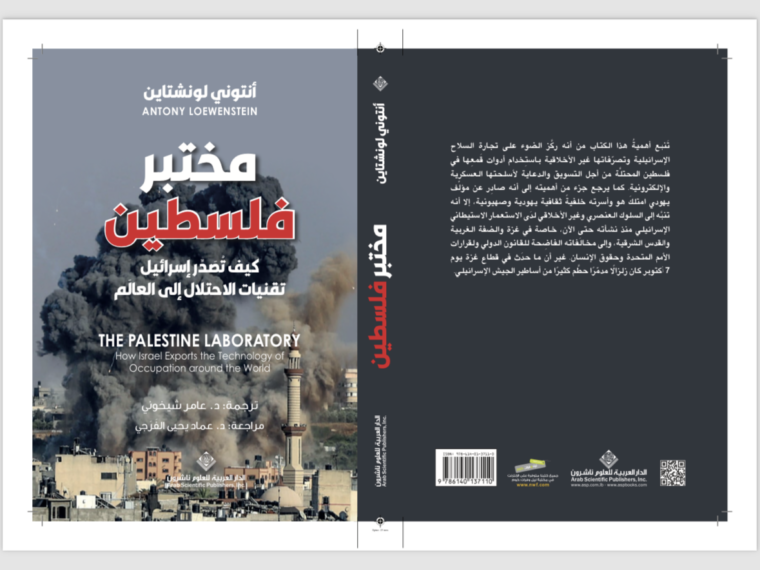
Last year I co-edited a book with Ahmed Moor called After Zionism (re-issued this week with an updated introduction). It’s about the one-state solution and the reasons this outcome is the most just for both Israelis and Palestinians.

This piece in Salon discusses, after Barack Obama’s visit to Israel and Palestine last week, the illusion of the two-state equation and the growing voices for a more equitable future:

While the “one-state solution,” however conceived, remains a semi-forbidden zone in mainstream international policy discourse, it keeps cropping up all over the place on both the right and the left. Within a few weeks last summer, leading Israeli settler activist Dani Dayan published an Op-Ed in the New York Times urging the international community to give up “its vain attempts to attain the unattainable two-state solution,” while radical journalists Antony Loewenstein and Ahmed Moor published an anthology of writing by academics and activists entitled “After Zionism: One State for Israel and Palestine.”

Less than a month later came the English translation of eminent Israeli sociologist Yehouda Shenhav’s explosive essay, “Beyond the Two-State Solution,” which imagines a bi-national, bilingual federal democracy of Jews and Arabs that would encompass the entire territory of present-day Israel, Gaza and the West Bank. Shenhav, Dayan, Loewenstein, Moor and the leadership of Israel’s staunch enemies Hamas and Hezbollah might agree about nothing else, including which day follows Tuesday and whether the sky is blue. But they’d all agree that a negotiated two-state solution won’t work. Indeed, Israeli film director Dror Moreh, who made the Oscar-nominated documentary “The Gatekeepers” and falls somewhere toward the pragmatic center of Israeli politics, recently told me the same thing. He sounded rueful about holding that opinion and thinks it’s still worth trying but suspects it’s simply too late.

Obama’s Jerusalem speech was aimed squarely at people like Moreh, who still support a peace deal but are inclined to believe it’s impossible. In a larger sense, the president was also trying to provide a boost to the fading momentum of the two-state cause. He spoke directly to the Israeli people, rather than to a divided Knesset dominated by Netanyahu’s hard-line coalition, precisely because a “one-state solution” (or, more properly, an enhanced version of the current one-state reality) has become the de facto position of the Israeli government. It’s difficult to find much distance between Netanyahu’s actual policies and Dani Dayan’s argument that “no final-status solution is imminent” and therefore all parties should focus on “intense efforts to improve and maintain the current reality on the ground.” Netanyahu’s version of kicking the can down the road works like this: We occasionally pay lip service to the idea of a negotiated settlement, at some distant future date when the Palestinians have essentially capitulated to Israel’s demands in advance, while continuing to build settlements that carve the territory of any hypothetical Palestinian state into Swiss cheese.

Rolling Israel’s borders back to the status quo ante of 1967 seems like a bizarre and impractical project in the first place, and as Ahmed Moor puts it, “the unacknowledged truth is that Palestine/Israel is already one country.” Roughly one-fifth of the people living inside Israel’s current borders are Arabs, and the Jewish population of the West Bank will likely soon reach or exceed that level. Extricating the two entities from each other after all this time will be something like separating conjoined twins who’ve grown most of the way to adulthood.

15 comments

Breaking news; Israel’s new government is fundamentally pro-colonies

Israeli peace group Gush Shalom issues the following statement:

March 18, 2013 – Today was established in Israel an extremist right-wing government in which settlers and their allies hold all the key positions: their Minister of Housing will construct settlement housing; their Minister of Industry will divert industries to the settlements; their Chairman of the Knesset Finance Committee will provide them with plenty of funds. The Minister of Defense – who is, in effect, the military dictator holding sway over the Occupied Territories – is opposed to any gesture towards the Palestinians, even the smallest and most symbolic. It is a government which appointed a minister to take charge of conducting negotiations with the Palestinians and an entire ministerial team to oversee such negotiations, but would not be able to conduct any such negotiations in reality.

The primary responsibility for Israel being saddled with such a pernicious and dangerous government does not rest with PM Netanyahu nor even with Naftali Bennett of the Jewish Home party. The main responsibility lies squarely upon Yair Lapid, the man who scored a big victory in the elections and frittered it away, who dealt a crushing blow to the right-wing block in Israeli politics and then single-handedly restored this same bloc to great power. Lapid’s supposedly “left of center” party won many more votes than Naftali Bennett’s extreme-right formation, but the alliance of these two parties worked entirely in favor of Bennett and his settlers.

Bennett had taken sober, well calculated steps, focusing on gaining the commanding positions in order to strengthen and bolster the West Bank settlement enterprise. Lapid wasted the incredibly strong position which fell into his hands in the aftermath of the elections, using it to advance marginal and insignificant objectives such as a reduction in the number of government ministers or recruiting members of Haredi Ultra-Orthdox community into the Israeli Army (an aim which would not be achieved in practice, anyway). Moreover, Lapid promoted some manifestly negative and harmful aims, such as steeply raising the electoral threshold which parties would need to cross to gain parliamentary representation – thus violating the democratic right of minorities in Israeli society to be represented.

Lapid only paid faint lip service to the need of negotiations with the Palestinians. But he even gave up without a struggle such major objectives of his constituency as civil marriage and public transportation on the Sabbath. Now he is getting ready to run the Ministry of Finance and implement austerity policies and severe budget cuts which would hurt the same middle class which Lapid purports to represent.

Hopefully, Lapid’s voters will remember all this at the next elections.

16 comments

That rare occasion when Australian politicians speak truths over Palestine

There were two examples in yesterday’s New South Wales parliament. Firstly, Labor Councillor Shaoquett Moselmane dared talk about the reality of Israeli crimes in Gaza and a host of other usually unutterable realities in polite company. There were then attempts to shut him down by his own party and the rapacious Zionist lobby. The usual suspects are scared that somebody may hear something contrary to a pro-apartheid and pro-occupation position. Cover your ears!

NSW Upper House Greens politician David Shoebridge gave the following powerful speech that challenged the wilful myopia expressed by nearly all politicians. A recent Zionist lobby trip took silly little politicians to Israel to get their fill of propaganda and falafel:

I speak to this motion and note at the outset that it is a very unbalanced one. Indeed, a member asked if The Greens took part in this study mission to Israel. As far as I am aware, no Greens member of Parliament went on this study mission. That was primarily because of the one-sided nature of the itinerary, which is reflected in the one-sided nature of this motion.

In a motion that purports to talk about building an understanding of the complex and various issues impacting on Israel and other jurisdictions within the Middle East, it is extraordinary that in the more than 100 words and five paragraphs of this motion not one word is mentioned about Palestine or the Palestinians. The human rights of the Palestinians are airbrushed out of the motion, just as they were airbrushed out of the itinerary of the study tour that travelled to Israel and some very small parts of the West Bank.

Having heard the contributions of members who went on the study tour and having read the motion, I can see that this is little more than a public relations exercise for the Israeli Government. Indeed, this public relations exercise has been run in part through the offices of the NSW Jewish Board of Deputies which arranged the tour and, I understand, partly paid for the study trip to Israel.

For the record, I do not recall getting an invitation from the Jewish Board of Deputies for this visit. However, had I received one I would not have accepted the invitation to go on this study trip because of the extraordinarily one-sided itinerary provided to members.

If the Parliamentary Friends of Israel were interested in building an understanding of the complex issues in the Middle East, as they purport to be, their itinerary should have included a couple of other places to visit. First, the itinerary should have included visits outside the limited confines of Israel, Jerusalem and Bethlehem.

How could members of this Chamber who wanted to get a balanced understanding of the issues facing the Israelis, the Palestinians and the Middle East travel to that part of the world and not meet with any members of the Palestinian Legislative Council, or at least those members of the Palestinian Legislative Council not currently being held in Israeli jails, many of them without trial and without being charged with any criminal offence?

How could members go there and meet with only one of the legislative bodies, the Knesset, and ignore the Palestinian Legislative Council? How could members, who wanted to get a balanced understanding of the issues facing Israel, Palestine and the Middle East, go to the other side of the planet and fail to visit Gaza, the world’s largest outdoor prison?

How could members not go to see the way the Palestinians live under the illegal blockade or not speak to the local health workers about the conditions in Gaza, or the paramedics about how they respond to the impacts of aerial bombardments by the Israeli military?

If they had visited Gaza they would have been able to see the X-rays that the Gaza doctors show of children’s kidneys riddled with kidney stones because of the saline water they are required to drink. The Israeli wells on the edge of Gaza are stripping out the fresh water from the arterial basin and the arterial basin is filling up with saline water from the sea. That saline water fills the wells. Most of the water treatment plants have been destroyed by Israeli bombardments and almost every child in Gaza has kidneys riddled with kidney stones and ongoing health problems.

Next time members should go to Gaza, look at the children, look at the damage, look at the X-rays and get some balance in their visit.

If they had gone to Gaza surely they would then have gone to the West Bank and outside Bethlehem and Jerusalem and spoken to Palestinian villagers whose lives and livelihoods have been destroyed by the apartheid wall. Talk to the farmers whose olive groves have been cut off by the illegal apartheid wall, who cannot get to the fields that generations of their family had previously tended because of an illegal apartheid wall built by Israel through the middle of their homes, villages and farms.

Surely members could also have met with Israeli peace activists, such as Jeff Halper from the Israeli Committee Against House Demolitions, and spoken to Palestinians who have been illegally evicted from their homes and land to make way for internationally condemned settlements being built by the Israelis.

But, no. Members spoke to the Israeli settlers but they did not visit and speak to the people who have been evicted illegally for these internationally condemned, unlawful settlements that are now riddling the West Bank.

How could members not have travelled to Hebron and done the Breaking the Silence tour, where former Israeli soldiers would have told them about what goes on in the occupied territories, about the violence and the discrimination perpetrated by the Israeli military and the settler movement against the native Palestinian population?

Or were they Israeli voices that members wanted to edit out and not hear? The inconvenient truth.

How could members not visit those Palestinian refugee camps in neighbouring countries such as Lebanon, where Palestinian refugees from 1948, 1967 and beyond live in sub-standard Third World conditions and are denied their human right to return to their homes? Members did not speak to them, see their title deeds and see the keys they still hold for the homes that were taken from them in the illegal occupations and evictions that have been taking place for decades in that part of the world?

It is extraordinary to note that Labor members, one of whom is notionally from the Left, visited Israel and small parts of the West Bank but did not travel to Nablus and meet with any of the Palestinian trade unions. How could members have travelled over there and not spoken to the firefighters in the Nablus fire station who were locked into their compound by Israeli tanks and snipers and prevented from doing their job as firefighters? They were prevented from saving the lives and homes of their families and friends for days and days as homes burned; children and other people died while the Israeli military shelled and burned their city around them.

The motion is not balanced; the visit to Israel was not balanced. It was not about getting an understanding of the complex and various issues but, rather, about getting a narrow part of the Israeli understanding.

For members who went on such an unbalanced tour and failed to see the balanced truth, the oppression the Palestinian people face daily as a result of the illegal occupation of Israel, and to support this motion and preach to the rest of the Chamber about truth, understanding, peace and non-violence is extraordinary.

Israeli journalist Gideon Levy on thankless task of reporting occupation

This Al-Jazeera documentary shows one of Israel’s courageous journalists, Haaretz’s Gideon Levy, as he documents his country’s brutal occupation and blindness towards it. As he says, Israel is that rare nation that practices apartheid and yet sees itself as the victim.

Levy is one of the most inspiring reporters I know:

13 comments

One million Jews coming to the West Bank

Haaretz editor Aluf Benn on Israel’s determination towards indefinite apartheid:

The third Netanyahu government has one clear goal: enlarging the settlements and achieving the vision of “a million Jews living in Judea and Samaria.” This magic number will thwart the division of the land and prevent once and for all the establishment of a Palestinian state. The defense, and housing and construction ministries that are relevant to this issue will be given to Likud MK Moshe Ya’alon and Habayit Hayehudi MK Uri Ariel. They won’t be assuming these positions in order to freeze settlement construction, but rather to implement the Levy report which determined that Israel was not legally-speaking an occupying power in the West Bank and the Habayit Hayehudi platform; or in other words, to gradually absorb the West Bank into Israel.

Netanyahu has used the term “the math” to explain the political difficulties that prevented him from being more flexible toward the Palestinians. That was in the previous Knesset term, when moderates like Ehud Barak and Dan Meridor were in senior government positions. In the new government, the math acts with abundant force against a compromise in the territories. The radical right wing is strengthened and united, and those who would claim Netanyahu’s mantle need the settlers’ support and will do everything in order to bribe them and make them happy.

Lapid and Livni are supposed to represent the foreign policy moderates, but they will have a tough time competing to be heard over ministers Ya’alon, Bennett, Gideon Sa’ar, Avigdor Lieberman and Yair Shamir. Lapid will be bought with trifles like the Sharing of the Civic Burden Law so that billions of shekels will continue to flow into the settlements, and Livni is too weak to have much influence.

Netanyahu’s key task will be buying some quiet on the Palestinian issue to permit the expansion of the settlements at the small price of international condemnation. He will continue with the successful ploy from his previous term: threatening an attack on Iran and Syria, which are drawing American attention. Barack Obama is busy with calming the Iranian front and preventing an eruption in and around Syria, and is ignoring Israel’s actions in the territories. This is the deal that Netanyahu will strive to achieve with Obama during their meetings next week in Jerusalem.

Netanyahu has lost his drawing power at the ballot box but leveraged to his benefit the rift in the opposing camp and formed a government that is outwardly aggressive and inwardly nationalistic. He has bound to himself the ambitious Lapid and Bennett, who will make an effort to prove themselves, and left out in the cold the hungry-eyed Haredim who will seek to utilize every crack in the coalition to crawl back into government. And as a final bonus, Netanyahu lowered the expectations of the Likud’s incumbent ministers, who gave up their dreams of an office upgrade and pleaded to be allowed to stay in their old ones. Impressive results in comparison with the disappointing election campaign of the “strong” Prime Minister Netanyahu.

10 comments